


The Unity Pathways School Division (UPSD) and its schools are narrative settings created for The Belonging Project. The stories within this ecosystem are inspired by real experiences in education and community life, thoughtfully fictionalized to protect privacy and illuminate inclusive practice.


The Unity Pathways School Division (UPSD) and its schools are narrative settings created for The Belonging Project. The stories within this ecosystem are inspired by real experiences in education and community life, thoughtfully fictionalized to protect privacy and illuminate inclusive practice.
▶ Story: Shining a Light: The Story of Jamila
Course: Strength-Based Practice: Seeing Students Differently

Jamila is a dedicated middle years teacher at Wayfinder Middle School. With over a decade of experience, she knows her students deeply—but lately, she’s been feeling a growing discomfort. As she works through the latest round of IPPs, she notices a pattern: each plan centers on problems. Pages filled with behaviors to fix, deficits to manage, and interventions to control. Even her most vibrant students—those full of creativity, humor, and leadership—are flattened into checklists and goals.
One afternoon, a passing conversation with a colleague stops her in her tracks. “What if your plans started from strengths?” the colleague asks. Jamila smiles politely but is stirred by the question. Could she really change her whole approach to documentation? What would it mean to stop fixing and start noticing? What began as a hallway conversation soon becomes a complete shift in how Jamila sees her role—and her students.
-
Prologue - More Than a Checklist ( 📖 Read | 🎧 Listen | 🎬 Watch )
-
Chapter 1 - Seeing What’s Already There ( 📖 Read | 🎧 Listen | 🎬 Watch )
-
Chapter 2 - Flipping the Script ( 📖 Read | 🎧 Listen | 🎬 Watch )
-
Chapter 3 - Profiles with Purpose ( 📖 Read | 🎧 Listen | 🎬 Watch )
-
Chapter 4 - Teaching From Strength ( 📖 Read | 🎧 Listen | 🎬 Watch )
-
Epilogue - Shining a Light ( 📖 Read | 🎧 Listen | 🎬 Watch )
▶ Story: The Joy Journal: The Story of Damien and Leo
Course: Strength-Based Practice: Seeing Students Differently

Damien is a thoughtful, steady educational assistant at Wayfinder Middle School. He works closely with Leo, a student with complex communication and mobility needs who requires intensive support throughout the school day. Most team meetings about Leo follow the same predictable pattern: charts of what Leo can’t do, notes on the support he requires, and concerns about what’s missing. Damien listens silently, growing increasingly uneasy with how these conversations flatten Leo’s identity.
Because in the quiet corners of the day, between routines and transitions, Damien sees something different. He sees the way Leo’s eyes light up when a peer sings off-key. He notices how Leo leans toward a window when it’s sunny or lifts his chin slightly when someone reads a funny passage aloud. These glimpses of joy aren’t formally documented anywhere. But to Damien, they matter.
One day, he decides to write them down, not in a spreadsheet, but in a simple notebook labeled Joy Journal. What began as a private act of noticing gradually transforms into a reimagining of what support can be. By leading with strengths and documenting moments of connection, Damien doesn’t just shift how Leo is supported, he starts to shift the mindset of an entire team.
-
Prologue - More Than a Glance ( 📖 Read | 🎧 Listen | 🎬 Watch )
-
Chapter 1 - Moments That Matter ( 📖 Read | 🎧 Listen | 🎬 Watch )
-
Chapter 2 - Rewriting the Narrative ( 📖 Read | 🎧 Listen | 🎬 Watch )
-
Chapter 3 - A Plan Rooted in Strength ( 📖 Read | 🎧 Listen | 🎬 Watch )
-
Chapter 4 - The Ripple Effect ( 📖 Read | 🎧 Listen | 🎬 Watch )
-
Epilogue - A Different Kind of Expertise ( 📖 Read | 🎧 Listen | 🎬 Watch )
▶ Story: Leading for All: Rhonda's Shift from Fixing to Designing
Course: Universal Design and Beyond: Designing for Human Variability

Meet Rhonda, a junior high vice principal at Wayfinder Middle School who began to notice a troubling pattern: accommodations were piling up, but barriers remained. Students were being “supported” but still excluded. In a school where IEP binders were growing thicker and teacher burnout rising, Rhonda asked a bold question: What if we planned differently from the start?
This story follows Rhonda’s journey from reactive systems to inclusive design, where supports are embedded into how teaching and learning happen for everyone. As she engages staff in rethinking the role of planning, language, and leadership, the culture begins to shift from “how do we fix this student?” to “how do we change the environment?”
It’s a story about designing with, not for, students, and about how leadership can quietly, steadily transform practice from the inside out.
-
Prologue - Beneath the Surface ( 📖 Read | 🎧 Listen | 🎬 Watch )
-
Chapter 1 - Another Red Folder ( 📖 Read | 🎧 Listen | 🎬 Watch )
-
Chapter 2 - If One, Then Many ( 📖 Read | 🎧 Listen | 🎬 Watch )
-
Chapter 3 - Planning for the Invisible ( 📖 Read | 🎧 Listen | 🎬 Watch )
-
Chapter 4 - The Culture of a Lesson Plan ( 📖 Read | 🎧 Listen | 🎬 Watch )
-
Epilogue - A New Lens for Leadership ( 📖 Read | 🎧 Listen | 🎬 Watch )
▶ Story: Wayfinder Middle School: A Sensory-Aware Classroom

At Wayfinder Middle School, a diverse and vibrant learning community, staff have long wrestled with rising behavior referrals, student shutdowns, and a persistent undercurrent of tension in the school environment. While educators genuinely care and strive to support each learner, they begin to realize that traditional classroom designs ((bright fluorescent lights, rigid seating, text-heavy instruction, and cluttered walls) might be adding to students’ overwhelm instead of easing it.
It starts with a hallway. One particularly loud transition between periods sparks a conversation among a small group of teachers: Why do some students leave the classroom more dysregulated than when they came in? This question leads to deeper inquiry into the connection between sensory input, regulation, and student engagement. Through collaboration and curiosity, a team begins to explore the concept of multimodal, sensory-aware design, not as a strategy for students with identified needs only, but as a foundation for inclusive teaching.
With administrative support, they visit a nearby classroom that has embedded regulation-aware strategies into daily practice. What they see sparks both inspiration and urgency. They return to Wayfinder ready to make meaningful shifts, not just by adding fidgets or changing seating, but by rethinking how sensory input is intentionally designed, how students can move and access information, and how instruction can respond to their emotional states.
Over time, their classrooms become spaces where students choose seating that supports their needs, engage through tactile and movement-based activities, and rely on visual supports to guide their learning. Students begin to self-regulate, participate more fully, and feel ownership over their learning environment. Staff begin to notice that discipline conversations are replaced by planning conversations. What began as a response to “behaviors” becomes a holistic rethinking of classroom culture—one grounded in safety, clarity, and trust.
-
Prologue - The Overstimulated Hallways ( 📖 Read | 🎧 Listen | 🎬 Watch )
-
Chapter 1 - Looking Through a New Lens ( 📖 Read | 🎧 Listen | 🎬 Watch )
-
Chapter 2 - Designing for Calm ( 📖 Read | 🎧 Listen | 🎬 Watch )
-
Chapter 3 - Hands-On Engagement ( 📖 Read | 🎧 Listen | 🎬 Watch )
-
Chapter 4 - Tools for Independence ( 📖 Read | 🎧 Listen | 🎬 Watch )
-
Epilogue - Beyond Behavior ( 📖 Read | 🎧 Listen | 🎬 Watch )
▶ Story: Tanya's Story: Coaching for Energy, Access and Autonomy
Course: Understanding Access Methods and Designing Access Points

At Wayfinder Middle School, Tanya works as an inclusive education coach with a growing awareness of an often-overlooked issue: the hidden challenges faced by students with chronic health conditions, fatigue disorders, and energy regulation needs. These students—some navigating long-term medical conditions, others managing post-viral fatigue or neurological differences—frequently miss out on full classroom participation, not because they lack ability, but because school structures rarely accommodate fluctuating energy levels. Tanya notices these students are absent more often, disengaged when present, and left behind in group tasks or assessments. Their needs are not always visible, and as a result, their potential is too often underestimated.
Rather than implementing rigid accommodations, Tanya begins by listening. She talks with students, meets with families, and reflects with teachers. What emerges is a clearer picture: students need options—not just for tasks, but for how and when they engage. They need classrooms that allow for rest without shame, participation without penalty, and pacing that respects their bodies. Tanya begins developing a coaching model rooted in universal design, trauma-informed pacing, and energy-aware planning.
Through collaborative design cycles, Tanya supports teams in reimagining classroom routines, expectations, and even grading practices. She helps teachers create flexible entry points, modify timing structures, and offer choice in how students demonstrate learning. As Tanya’s work unfolds, it catalyzes a shift from compliance-based inclusion to dignity-centered design—where students with invisible disabilities are seen, supported, and celebrated for who they are.
-
Prologue - Invisible Barriers ( 📖 Read | 🎧 Listen | 🎬 Watch )
-
Chapter 1 - Energy as a Design Variable ( 📖 Read | 🎧 Listen | 🎬 Watch )
-
Chapter 2 - Designing for Flexibility ( 📖 Read | 🎧 Listen | 🎬 Watch )
-
Chapter 3 - Supporting Student Voice ( 📖 Read | 🎧 Listen | 🎬 Watch )
-
Chapter 4 - Building a New Normal ( 📖 Read | 🎧 Listen | 🎬 Watch )
-
Epilogue - A Culture of Consideration ( 📖 Read | 🎧 Listen | 🎬 Watch )
▶ Story: Starting Somewhere: Executive Function as an Access Point
Course: Understanding Access Methods and Designing Access Points

Elias is a quiet and perceptive Grade 8 student at Wayfinder Middle School. While his teachers describe him as capable and insightful, they also express growing concern about his inconsistent work habits. Elias often stares blankly at the start of class, fidgets with unrelated objects, or gazes out the window when others begin working. Assignments are frequently left incomplete. Teachers believe this is not because he lacks the skill or knowledge, but because they never really get off the ground. To many, it looks like he just doesn’t care.
But a deeper look reveals something else entirely. Elias is not defiant. He’s stuck. His brain struggles with executive functioning tasks like planning, organizing, and initiating. Starting is the hardest part. Once he’s in the flow, he can contribute thoughtful ideas and original work. Unfortunately, classroom structures often assume that students know how to begin, how to plan, and how to persist, all of which are invisible hurdles for Elias.
After a student services team meeting and some intentional observation, Elias’s teachers begin shifting their lens. Instead of framing the problem as motivation, they begin to understand it as access. Access to the “how” of learning, not just the “what.” With small, strategic supports like visual checklists, clear planning routines, and student agency Elias begins to build momentum. His story shows how executive function isn’t just a clinical label, but a powerful access point for equity and engagement when educators lean in with curiosity and design with intention.
-
Prologue - Misunderstood Starts ( 📖 Read | 🎧 Listen | 🎬 Watch )
-
Chapter 1 - Shifting the Lens ( 📖 Read | 🎧 Listen | 🎬 Watch )
-
Chapter 2 - Structure That Supports ( 📖 Read | 🎧 Listen | 🎬 Watch )
-
Chapter 3 - Rethinking Motivation ( 📖 Read | 🎧 Listen | 🎬 Watch )
-
Chapter 4 - Stepping In and Stepping Back ( 📖 Read | 🎧 Listen | 🎬 Watch )
-
Epilogue - Building Momentum ( 📖 Read | 🎧 Listen | 🎬 Watch )
▶ Story: Simran's Story: Leading Culture Change

Meet Simran, the newly appointed principal of Wayfinder Middle School, a place once known more for its office referrals than its relationships. With rising suspensions, teacher burnout, and fractured trust between students and staff, Simran steps into a system in survival mode. But instead of doubling down on control, she listens—and leads with empathy.
Rooted in a belief that behavior is communication, Simran embarks on a schoolwide journey to reimagine discipline, not as punishment, but as an opportunity for understanding and restoration. She shifts the lens from student compliance to collective regulation—centering co-regulation, relational safety, and adult emotional literacy. Along the way, she learns that to transform a culture, you must first transform how people feel in it.
Her story reveals how a middle school can move from reactive crisis management to proactive design: redesigning transitions, building calm entry routines, investing in staff regulation, and embedding restorative practices. It’s a story of leadership that holds complexity with compassion—and walks alongside others toward a culture of belonging.
-
Prologue - This Isn’t Working ( 📖 Read | 🎧 Listen | 🎬 Watch )
-
Chapter 1 - Punishment or Pattern? ( 📖 Read | 🎧 Listen | 🎬 Watch )
-
Chapter 2 - Designing the Day Differently ( 📖 Read | 🎧 Listen | 🎬 Watch )
-
Chapter 3 - Regulation is Contagious ( 📖 Read | 🎧 Listen | 🎬 Watch )
-
Chapter 4 - Restoring the We ( 📖 Read | 🎧 Listen | 🎬 Watch )
-
Epilogue - Culture Shift ( 📖 Read | 🎧 Listen | 🎬 Watch )
▶ Story: Finding Strength in Shared Stories

Meet Zach, a Grade 7 student at Wayfinder Middle School who has long believed he is “just not a reader.” Despite his natural curiosity and verbal creativity, years of struggling with traditional reading tasks have led Zach to withdraw during literacy instruction. He often appears disengaged in reading groups, hesitant to contribute, and avoids written responses. His teachers see flashes of insight during class discussions, but his written assignments rarely reflect the depth of his thinking.
Ms. Donovan, a language arts teacher committed to inclusive practice, notices Zach’s discomfort. When planning a novel study, she experiments with a new approach—one that organizes students into interest-based reading groups rather than ability levels. With this small but intentional shift, Zach finds himself in a group reading a graphic novel about youth-led climate justice movements, a topic that resonates with his growing passion for the environment. What begins as an experiment in grouping transforms into a journey of identity, voice, and academic confidence.
Through collaborative roles, authentic dialogue, and personalized pathways for expression, Zach starts to reframe what it means to be a reader and begins to believe he belongs in the circle of learners.
-
Prologue - The Reluctant Reader ( 📖 Read | 🎧 Listen | 🎬 Watch )
-
Chapter 1 - A New Grouping Model ( 📖 Read | 🎧 Listen | 🎬 Watch )
-
Chapter 2 - Planning With Students ( 📖 Read | 🎧 Listen | 🎬 Watch )
-
Chapter 3 - Encouraged to Lead ( 📖 Read | 🎧 Listen | 🎬 Watch )
-
Chapter 4 - Reading, Rethought ( 📖 Read | 🎧 Listen | 🎬 Watch )
-
Epilogue - A Shift in Identity ( 📖 Read | 🎧 Listen | 🎬 Watch )
▶ Story: From Points to Partnership

Mrs. Graham has been teaching for over a decade at Wayfinder Middle School. Known for her calm, structured classroom, she relies on predictable routines, a points-based reward system, and clearly posted behavior charts. The classroom runs smoothly but over time, she begins to wonder if smooth is the same as meaningful. She notices students complying, but not engaging. They follow rules, but rarely express themselves. Most classroom decisions begin and end with her.
A shift begins after a professional development session on dignity in education. Mrs. Graham is struck by one question: “How often do students get to shape the systems that govern them?” She surveys her class, expecting vague answers but instead receives insightful feedback about fairness, motivation, and the desire for more autonomy.
Encouraged, she removes the points system and co-creates classroom agreements with her students. Together, they explore what it means to contribute to a community. Reflection tools replace behavior logs. Restorative circles become part of weekly practice. As students are given opportunities to take ownership, Mrs. Graham sees them rise to the occasion. They start solving problems, supporting each other, and voicing concerns with increasing maturity.
The real turning point comes when the class organizes a student-led community lunch. From budgeting to invitation design, they manage the event themselves. Mrs. Graham watches from the edges, no longer the controller, but the coach. She journals later that evening: “I haven’t lost control. I’ve gained trust.” Her classroom is no longer managed by points. It’s shaped by partnership.
-
Prologue - The Behavior Binder ( 📖 Read | 🎧 Listen | 🎬 Watch )
-
Chapter 1 - The Question That Lingered ( 📖 Read | 🎧 Listen | 🎬 Watch )
-
Chapter 2 - Making Space for Voice ( 📖 Read | 🎧 Listen | 🎬 Watch )
-
Chapter 3 - Repair and Restore ( 📖 Read | 🎧 Listen | 🎬 Watch )
-
Chapter 4 - Leading the Way ( 📖 Read | 🎧 Listen | 🎬 Watch )
-
Epilogue - Becoming the Guide ( 📖 Read | 🎧 Listen | 🎬 Watch )
▶ Story: A Stage for Friendship
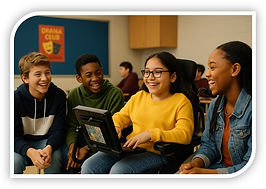
Aliyah is a creative and thoughtful Grade 8 student at Wayfinder Middle School. She uses a power wheelchair for mobility and a speech-generating AAC device to communicate. Although she enjoys school and is welcomed by peers, her relationships tend to stay surface-level. They are warm but distant. At lunch, she often eats beside her educational assistant, Ms. Nguyen, watching other students chat and joke in groups she’s rarely invited into. It’s not that others are unkind. They just don’t quite know how to connect.
Ms. Nguyen sees Aliyah’s longing for more. She notices how animated Aliyah becomes when storytelling or playing with dialogue on her device. When a poster for the school drama club goes up, a spark of possibility is lit. Could this be a path to deeper connection?
With support from the drama club’s teacher-sponsor, Ms. Nguyen helps make participation feasible and welcoming. Rehearsals are adapted, peer buddies are introduced, and opportunities to contribute both onstage and off are made visible. Aliyah begins writing scripts, suggesting costume ideas, and eventually delivering lines during a school production using her AAC.
What starts as a hopeful experiment becomes a turning point. Aliyah’s peers begin seeing her not only as capable, but as creative, funny, and deeply insightful. Lunchtimes shift from quiet solitude to lively group chats. A once-silent observer becomes a sought-out collaborator and friend. Her journey reminds the school community that belonging doesn’t just happen inside classrooms. It is built in the spaces where students share laughter, creativity, and purpose.
-
Prologue - On the Edges ( 📖 Read | 🎧 Listen | 🎬 Watch )
-
Chapter 1 - Stepping In ( 📖 Read | 🎧 Listen | 🎬 Watch )
-
Chapter 2 - More Than a Role ( 📖 Read | 🎧 Listen | 🎬 Watch )
-
Chapter 3 - A Cast of Connection ( 📖 Read | 🎧 Listen | 🎬 Watch )
-
Chapter 4 - Behind the Curtain, In the Spotlight ( 📖 Read | 🎧 Listen | 🎬 Watch )
-
Epilogue - Connected and Seen ( 📖 Read | 🎧 Listen | 🎬 Watch )
▶ Story: Small Shifts, Big Impact

Darren is a calm, observant educational assistant at Wayfinder Middle School who rarely draws attention to himself but his impact is deeply felt. Assigned to support students with a variety of access needs, Darren spends much of his day circulating between classrooms and common areas, checking in, coaching, and quietly guiding students through routines. Over time, he begins to notice something troubling: students with disabilities or social differences often sit alone at lunch. Some eat in silence, others scroll through their devices, and a few leave the cafeteria entirely. Although peers are rarely unkind, they’re often unsure of how to engage. Invisible barriers persist.
The pattern is familiar to Darren. He remembers what it felt like to be overlooked in his own middle school years. He was awkward, unsure of where to sit, often retreating to corners. He knows firsthand how isolating school can feel when you don’t quite fit the mold. One day, instead of watching from the sidelines, Darren takes his lunch tray and sits down with a group of students who often sit alone. He doesn’t make a speech or force interaction. He just pulls up a chair and starts a casual conversation. The next day, he does it again. And then again.
What starts as a quiet gesture soon ripples outward. Darren suggests rotating peer lunch tables with simple prompts to help students connect. He collaborates with teachers to rework group projects so every student, regardless of support needs, can meaningfully contribute. He begins mentoring a small group of peer supporters, coaching them on how to include others intentionally and respectfully. Slowly, the culture begins to shift. Lunchtime grows louder, more joyful, and more mixed. Students stop seeing “those kids” and start seeing their classmates.
Darren’s story reminds us that inclusion isn’t always built through grand programs or sweeping reforms. Sometimes, it starts with a tray, a question, and a willingness to sit beside someone who’s been left out. Through everyday interactions, Darren helps change the social fabric of Wayfinder, from the margins inward.
-
Prologue - Lunchtime Walls ( 📖 Read | 🎧 Listen | 🎬 Watch )
-
Chapter 1 - One Table at a Time ( 📖 Read | 🎧 Listen | 🎬 Watch )
-
Chapter 2 - Learning Together ( 📖 Read | 🎧 Listen | 🎬 Watch )
-
Chapter 3 - Connections Multiply ( 📖 Read | 🎧 Listen | 🎬 Watch )
-
Chapter 4 - It’s What We Do Now ( 📖 Read | 🎧 Listen | 🎬 Watch )
-
Epilogue - Ordinary, Yet Transformational ( 📖 Read | 🎧 Listen | 🎬 Watch )