


The Unity Pathways School Division (UPSD) and its schools are narrative settings created for The Belonging Project. The stories within this ecosystem are inspired by real experiences in education and community life, thoughtfully fictionalized to protect privacy and illuminate inclusive practice.


The Unity Pathways School Division (UPSD) and its schools are narrative settings created for The Belonging Project. The stories within this ecosystem are inspired by real experiences in education and community life, thoughtfully fictionalized to protect privacy and illuminate inclusive practice.
▶ Story: From Case to Kid: The Story of Elias
Course: Strength-Based Practice: Seeing Students Differently

At Riverstone Elementary, Ms. Clarke is preparing for the new school year when a thick cumulative file lands on her desk. It's Elias’s. Labels jump off the page: “slow processing,” “disorganized,” “reading below grade level,” “inattentive.” The tone is clinical, focused on gaps, deficits, and compliance goals.
But when Elias walks into her classroom, he’s a burst of life, chatting enthusiastically with a classmate about the Perseid meteor shower and sketching planets on the back of his agenda. Within minutes, Ms. Clarke hears words like celestial, gravitational pull, and orbiting bodies. She pauses. This isn't the student described in the file.
Rather than dismissing the paperwork, Ms. Clarke treats it as only part of the story. What she sees in front of her is something different: a learner brimming with curiosity, especially about space. Over the following weeks, she begins tuning in—watching Elias’s eyes light up during science discussions, noticing how he perseveres through reading when the topic is astronomy.
She wonders: What would happen if we planned from his strengths rather than around his struggles?
As she shifts her lens, so does Elias’s trajectory. What was once seen as noncompliance becomes creative divergence. What was previously “scattered” is now “innovative.” Through intentional design, strengths-based feedback, and co-authored learning experiences, Elias steps into his own identity, not as a struggling student, but as a capable, confident learner.
By year’s end, Elias isn’t just “improving". He’s inspiring. And Ms. Clarke knows the truth: he was never a problem to fix. He was a scientist waiting to be seen.
-
Prologue - A File Full of Deficits ( 📖 Read | 🎧 Listen | 🎬 Watch )
-
Chapter 1 - Curiosity as Compass ( 📖 Read | 🎧 Listen | 🎬 Watch )
-
Chapter 2 - Rethinking the Problem ( 📖 Read | 🎧 Listen | 🎬 Watch )
-
Chapter 3 - Voices That Matter ( 📖 Read | 🎧 Listen | 🎬 Watch )
-
Chapter 4 - Designing Around Strength ( 📖 Read | 🎧 Listen | 🎬 Watch )
-
Epilogue - From Case to Kid ( 📖 Read | 🎧 Listen | 🎬 Watch )
▶ Story: Designing for Belonging: Marnie's Shift Toward Inclusive Practice
Course: Universal Design and Beyond: Designing for Human Variability

Meet Marnie, a Grade 3/4 teacher navigating the daily realities of a split 3/4 classroom at Riverstone Elementary School. Pressured to cover curriculum and meet diverse student needs, she often finds herself overwhelmed, exhausted by constant one-off adaptations that fail to reach every learner. But a growing discomfort nudges her to question: What if the problem isn’t the students—but the design?
As Marnie begins to explore Universal Design for Learning, she shifts her focus from reacting to deficits to proactively designing for strengths. Through moments of vulnerability, trial and error, and collaboration with colleagues, Marnie begins to create choice-based, multimodal learning experiences that invite all students into the heart of the classroom.
Her journey reflects the messiness and joy of inclusive practice: students who once disengaged begin to re-enter learning; assessments become celebrations of growth; and the classroom moves from survival mode to a space where everyone belongs, including the teacher.
This story is for any educator who has ever felt stuck in the pressure to do it all and is ready to design differently.
-
Prologue - Caught in the Currents ( 📖 Read | 🎧 Listen | 🎬 Watch )
-
Chapter 1 - The Blur of Expectations ( 📖 Read | 🎧 Listen | 🎬 Watch )
-
Chapter 2 - Starting from the Edges ( 📖 Read | 🎧 Listen | 🎬 Watch )
-
Chapter 3 - What They Need to See ( 📖 Read | 🎧 Listen | 🎬 Watch )
-
Chapter 4 - Evidence of Learning, Differently ( 📖 Read | 🎧 Listen | 🎬 Watch )
-
Epilogue - A Classroom Transformed ( 📖 Read | 🎧 Listen | 🎬 Watch )
▶ Story: Leo's Story: A Voice Beyond Words

Leo, a non-speaking Grade 5 student, arrives at Riverstone Elementary School mid-year. His previous learning experiences have been fragmented, with support often focused on managing behaviors or providing basic care rather than nurturing communication, agency, and academic inclusion. At Riverstone, however, a new team of educators is determined to do things differently.
From the start, Leo is attentive and curious. He listens closely during lessons, tracks classroom routines, and explores learning materials with clear interest, but he doesn’t speak, and his gestures are often missed or misunderstood. His new teachers, Ms. Howell and Mr. Tran, feel a mixture of hope and hesitation. They’ve never supported a student who uses augmentative and alternative communication (AAC), and they worry about how to make complex subjects like science accessible without overwhelming him, or themselves.
Their uncertainty becomes a catalyst for growth. With the help of a speech-language pathologist and the learning support team, they begin to see communication not as a set of words, but as a dynamic and multimodal process. They learn about objects of reference, visual symbols, simplified text, touch-based AAC, and the importance of consistency and predictability. What begins as a plan to “support Leo” soon evolves into a broader redesign of classroom communication for all learners.
As visuals become embedded in science labs, instructions, schedules, and group tasks, Leo begins to light up. He uses symbols, objects, gestures, and buttons to show understanding and share ideas. His classmates respond with growing empathy and recognition. Slowly, the classroom shifts, not to accommodate Leo, but to include him. By the end of the unit, he’s not just participating—he’s leading. And his teachers are no longer asking, Can Leo do this? They’re asking, How can we design so everyone does?
-
Prologue - The Quiet Observer ( 📖 Read | 🎧 Listen | 🎬 Watch )
-
Chapter 1 - Learning New Languages ( 📖 Read | 🎧 Listen | 🎬 Watch )
-
Chapter 2 - Designing Entry Points ( 📖 Read | 🎧 Listen | 🎬 Watch )
-
Chapter 3 - Group Work, New Voices ( 📖 Read | 🎧 Listen | 🎬 Watch )
-
Chapter 4 - Visuals for Agency ( 📖 Read | 🎧 Listen | 🎬 Watch )
-
Epilogue - Leading the Lab ( 📖 Read | 🎧 Listen | 🎬 Watch )
▶ Story: The School That Speaks Together
Course: Understanding Access Methods and Designing Access Points

A School That Speaks Together
At Riverstone Elementary, teachers and support staff begin to notice a pattern. More students are arriving with Augmentative and Alternative Communication (AAC) needs. These students use speech-generating devices, symbol boards, or gestures to communicate. While the school has always valued inclusion, these students often sit at the edges of classroom conversations. Teachers rely heavily on educational assistants or speech-language pathologists for support, unintentionally limiting communication to adult-managed moments. Staff begin asking questions: How do we bring AAC into the center of classroom life, rather than keeping it at the periphery?
In one staff meeting, a school-based speech-language pathologist (SLP) proposes a radical but simple shift: What if AAC wasn’t just for a few students? What if the school implemented a universal core word approach, embedding visual supports and shared vocabulary across all classrooms and activities? The idea receives a mix of excitement and hesitation. Some teachers worry about adding more to their already full plates, but others are intrigued by the possibility of creating a truly communicative culture for all students.
With support from leadership and the SLP, the school begins slowly. Teachers try modeling one or two core words each week. Visuals are introduced in classroom routines, morning meetings, and hallway transitions. Educational assistants begin co-planning with teachers. Students who had once remained silent begin engaging—first with symbols, then gestures, and eventually with increased confidence and connection. As the months progress, what began as an AAC strategy for a handful of learners grows into a whole-school movement. The shift fosters greater empathy, awareness, and inclusivity, where all voices, no matter how they are expressed, are honored and heard.
-
Prologue - A Pattern of Silence ( 📖 Read | 🎧 Listen | 🎬 Watch )
-
Chapter 1 - Building a Core Word Culture ( 📖 Read | 🎧 Listen | 🎬 Watch )
-
Chapter 2 - Communication Beyond Device ( 📖 Read | 🎧 Listen | 🎬 Watch )
-
Chapter 3 - Shared Responsibility ( 📖 Read | 🎧 Listen | 🎬 Watch )
-
Chapter 4 - Community of Communicators ( 📖 Read | 🎧 Listen | 🎬 Watch )
-
Epilogue - A Language-Rich School ( 📖 Read | 🎧 Listen | 🎬 Watch )
▶ Story: Pathways Through Numbers

Explore Riverstone Elementary, where a group of educators notice a persistent challenge in their math classrooms: while some students quickly move through assignments, others sit frozen with uncertainty. Despite a strong math curriculum and ample resources, engagement and confidence remain uneven across grade levels. The school’s instructional leadership team begins to wonder what if it’s not the students who need fixing, but the way learning is structured?
They begin to question the tradition of one-path math instruction. Instead of grouping students by perceived ability, they explore ways to offer multiple entry points into mathematical thinking, ones that honour how learners differ in pace, processing, and preference. Teachers begin experimenting with choice boards, learning progressions, and peer-supported “math labs.” Some students gravitate toward hands-on tools, others toward storytelling or visual strategies, and some toward more abstract approaches.
As the model evolves, students begin to see themselves as capable mathematicians, regardless of their starting point. Confidence grows, and so does collaboration. Through reflection and iteration, Riverstone’s educators witness something profound: when students have voice in how they approach a task, they are not only more engaged, but more willing to persist. Math becomes less about getting it “right” and more about exploring, justifying, and owning one’s learning journey.
-
Prologue - One Size Doesn’t Fit All ( 📖 Read | 🎧 Listen | 🎬 Watch )
-
Chapter 1 - Math Choice Boards ( 📖 Read | 🎧 Listen | 🎬 Watch )
-
Chapter 2 - Clarity Through Progressions ( 📖 Read | 🎧 Listen | 🎬 Watch )
-
Chapter 3 - Flexible Math Labs ( 📖 Read | 🎧 Listen | 🎬 Watch )
-
Chapter 4 - Owning the Journey ( 📖 Read | 🎧 Listen | 🎬 Watch )
-
Epilogue - Data-Informed Decisions ( 📖 Read | 🎧 Listen | 🎬 Watch )
▶ Story: Agency Begins in Play
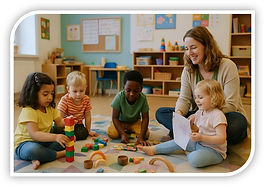
At Riverstone Elementary, the early learning classroom is filled with energy, imagination, and potential. The children are vibrant storytellers, engineers of block towers, and explorers of bugs and puddles. And yet, their days often follow a rhythm pre-set by adults. Centers predetermined, materials laid out, schedules tightly structured. Educators begin to wonder: What if we listened more deeply? What if our planning followed their lead?
This question sparks a quiet revolution in practice. Instead of simply delivering a play-based program, the early years team commits to co-constructing learning with children. They begin documenting the children's questions, ideas, and play narratives, using these as blueprints for planning. Morning meetings transform into planning circles. Centers are no longer themed by the calendar. They emerge from the children’s fascinations. A single conversation about dinosaur bones becomes a full-blown museum. A pretend kitchen evolves into a bakery with menus, orders, and “customers.”
The educators stop trying to direct every moment and instead begin to trust the leadership of young children. They scaffold emerging literacy, numeracy, and social-emotional learning through play-based experiences rooted in agency. Children choose how to express their ideas through drawing, dance, construction, or storytelling. They take on real responsibilities: documenting the weather, leading classroom rituals, caring for the space, and welcoming visitors.
In this story, agency is not about rushing children toward independence. It’s about honouring their voices and recognizing leadership as something that begins in play, long before formal schooling begins. The classroom becomes a space of shared power, deep belonging, and joyful learning. One where every child knows their ideas matter.
-
Prologue - Tiny Voices, Big Ideas ( 📖 Read | 🎧 Listen | 🎬 Watch )
-
Chapter 1 - Listening Differently ( 📖 Read | 🎧 Listen | 🎬 Watch )
-
Chapter 2 - Thematic Planning Together ( 📖 Read | 🎧 Listen | 🎬 Watch )
-
Chapter 3 - Expression Without Limits ( 📖 Read | 🎧 Listen | 🎬 Watch )
-
Chapter 4 - Responsibility in Little Hands ( 📖 Read | 🎧 Listen | 🎬 Watch )
-
Epilogue - Play as Leadership ( 📖 Read | 🎧 Listen | 🎬 Watch )
▶ Story: Connecting Through Culture

Logan is a quiet and observant Grade 5 student at Riverstone Elementary School. He keeps to himself most of the time, content to read during recess or sketch quietly at his desk. Teachers describe him as kind and bright but often invisible. Despite efforts like buddy systems and lunch clubs, Logan has struggled to form lasting peer connections. The social world of school seems distant, and his teachers are unsure how to draw him in without overwhelming him.
Ms. Cardinal, the division’s Indigenous support worker, sees something more. She notices how Logan lights up when they talk about his Métis heritage, and how his whole posture shifts when he’s beading or listening to fiddle music. She begins to wonder: What if Logan didn’t have to leave his culture at the classroom door? What if his identity became the bridge to belonging?
With Ms. Cardinal’s support, Logan is invited to help co-create a Métis storytelling display for the school’s cultural week. He’s hesitant at first but when another student named Evan joins him out of curiosity, something shifts. The two boys begin working together, sharing stories, experimenting with traditional crafts, and preparing a short presentation. Their collaboration becomes the starting point of deeper peer relationships and broader cultural inclusion across the school.
As Logan’s story unfolds, the classroom begins to shift. Cultural identity becomes a source of connection, not separation. Students begin to share their own traditions and stories. With guidance from Elders and the steady presence of Ms. Cardinal, Logan moves from the quiet corners of the school into its heart, not by changing who he is, but by being seen more fully. His story becomes a reminder that belonging is not something we give. It's something we co-create by honouring the stories that live within each student.
-
Prologue - Quiet Corners ( 📖 Read | 🎧 Listen | 🎬 Watch )
-
Chapter 1 - Cultural Pathways ( 📖 Read | 🎧 Listen | 🎬 Watch )
-
Chapter 2 - Shared Stories ( 📖 Read | 🎧 Listen | 🎬 Watch )
-
Chapter 3 - Reciprocal Belonging ( 📖 Read | 🎧 Listen | 🎬 Watch )
-
Chapter 4 - Widening the Circle ( 📖 Read | 🎧 Listen | 🎬 Watch )
-
Epilogue - Belonging Rooted in Identity ( 📖 Read | 🎧 Listen | 🎬 Watch )
▶ Story: Quiet, But Present

Tessa is a thoughtful, observant Grade 4 student at Riverstone Elementary School. For over a year, she hasn’t spoken aloud at school. Not during class, not at recess, not even in small groups. Diagnosed with selective mutism, Tessa communicates freely at home but becomes completely silent in school environments. Her teachers care deeply but feel uncertain about how to build her confidence and connection. Peers are kind, but unsure how to engage. She often sits quietly in group settings, watching rather than participating. Present, but unseen.
What few people notice at first is that Tessa is a gifted artist. Her journals are full of vibrant drawings, clever captions, and expressive characters. Her written work reveals insight, humor, and emotional depth. One day, during independent writing, her teacher notices a quiet note passed between Tessa and a classmate named Amari. It’s not a disruption. It’s a beautifully drawn comic panel, co-created in silence. This quiet exchange sparks an idea: What if connection didn’t always need to be verbal? What if expression could take many forms?
From that moment, Tessa’s world begins to open. Her teacher introduces multimodal journaling, peer writing prompts, and silent collaborative art. Amari becomes a steady friend and creative partner, helping Tessa share her voice through pictures and stories. Slowly, the classroom begins to shift. Communication is no longer limited to words. It’s built through drawing, writing, gestures, and shared experiences.
Tessa’s story reveals a profound truth: that belonging doesn’t depend on speaking out loud. It grows when students are given space to express who they are in the ways that feel safest. Through inclusive expression, Tessa finds her place, not just as someone who is tolerated in silence, but as someone deeply known and cherished.
-
Prologue - The Silent Seat ( 📖 Read | 🎧 Listen | 🎬 Watch )
-
Chapter 1 - Making Space ( 📖 Read | 🎧 Listen | 🎬 Watch )
-
Chapter 2 - Paper Friendships ( 📖 Read | 🎧 Listen | 🎬 Watch )
-
Chapter 3 - Being Known ( 📖 Read | 🎧 Listen | 🎬 Watch )
-
Chapter 4 - Without Words ( 📖 Read | 🎧 Listen | 🎬 Watch )
-
Epilogue - Friendship in Many Forms ( 📖 Read | 🎧 Listen | 🎬 Watch )