


The Unity Pathways School Division (UPSD) and its schools are narrative settings created for The Belonging Project. The stories within this ecosystem are inspired by real experiences in education and community life, thoughtfully fictionalized to protect privacy and illuminate inclusive practice.


The Unity Pathways School Division (UPSD) and its schools are narrative settings created for The Belonging Project. The stories within this ecosystem are inspired by real experiences in education and community life, thoughtfully fictionalized to protect privacy and illuminate inclusive practice.
▶ Story: Jeremy's Story: Designing with, Not For
Course: Universal Design and Beyond: Designing for Human Variability

Jeremy is a bright and ambitious high school student with cerebral palsy who attends Prairie View School, a rural K–12 school working to become more inclusive. While Jeremy excels in academic subjects and demonstrates strong leadership skills, his participation in science labs and physical education is often limited by the physical setup of classrooms and traditional expectations for engagement. Teachers want to include him more fully but are unsure how to move beyond basic physical accommodations.
Early in the school year, Jeremy’s science teacher initiates a conversation with him about classroom barriers. Instead of assuming what Jeremy needs, she invites him to co-lead an accessibility audit. Together, they assess lab equipment, counter heights, safety procedures, and peer collaboration expectations. What begins as a practical adjustment project quickly evolves into a partnership rooted in mutual respect. Jeremy’s voice becomes central—not only in redesigning the physical space, but in reimagining how participation itself is defined.
Over time, Jeremy helps his school see access through a broader lens. He co-develops flexible lab group roles, introduces adaptive tools, and even co-leads a redesign of gym circuits to include students with varied mobility. His insights inspire his peers and teachers to think differently—not just about disability, but about student agency and design thinking. His graduation project, a toolkit on student-driven access planning, becomes a school-wide resource and earns district-wide recognition.
Jeremy’s story is not one of overcoming disability, but of redefining access through collaboration and creativity. His journey challenges the school to shift from providing accommodations to co-creating inclusive design—and demonstrates that designing with students can unlock innovation and equity for everyone.
-
Prologue - Strength in Stillness ( 📖 Read | 🎧 Listen | 🎬 Watch )
-
Chapter 1 - Mapping Physical Barriers ( 📖 Read | 🎧 Listen | 🎬 Watch )
-
Chapter 2 - Creative Access Points ( 📖 Read | 🎧 Listen | 🎬 Watch )
-
Chapter 3 - Co-Designing With Purpose ( 📖 Read | 🎧 Listen | 🎬 Watch )
-
Chapter 4 - Voice and Visibility ( 📖 Read | 🎧 Listen | 🎬 Watch )
-
Epilogue - An Agent of Access ( 📖 Read | 🎧 Listen | 🎬 Watch )
▶ Story: Language, Land, and Learning
Course: Understanding Access Methods and Designing Access Points
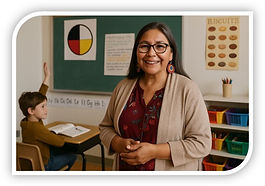
At Prairie View School, efforts to support inclusion have largely centered around academic accommodations and physical accessibility. Classrooms are becoming more adaptable, and teachers are beginning to implement Universal Design for Learning strategies. But Sherry, a Cree educational assistant and community knowledge keeper, quietly observes that something deeper is still missing for many of her Indigenous students. Despite these surface-level changes, some students seem disengaged, withdrawn, or emotionally distant. She senses an invisible barrier, one tied not to ability, but to identity.
Sherry begins gently opening conversations with staff, asking how they define access and inclusion. For her, true access also means connection to culture, language, land, and spiritual practices. She shares stories and teachings passed down in her own family and helps teachers see how identity-affirming learning experiences can be a powerful entry point. Slowly, teachers begin to listen. They start asking different questions, not just “Can the student complete this task?” but “Does this learning invite them to show up fully?”
Throughout the year, Sherry co-plans classroom activities that honor seasonal rhythms, integrate Indigenous languages, and create space for land-based learning. She collaborates with Elders, builds relationships with families, and supports students in walking between worlds, their community traditions and the expectations of formal schooling. Her presence invites not only new practices, but new mindsets: that access must be defined by those seeking it, and that inclusion without cultural responsiveness is still a form of exclusion.
Sherry’s story reveals that inclusion is not just structural—it’s deeply relational. It asks educators to move beyond standard supports and co-create environments where every learner sees themselves reflected in the curriculum, respected in the community, and rooted in who they are.
-
Prologue - Beyond the Physical ( 📖 Read | 🎧 Listen | 🎬 Watch )
-
Chapter 1 - Reframing Access ( 📖 Read | 🎧 Listen | 🎬 Watch )
-
Chapter 2 - Identity-Aligned Design ( 📖 Read | 🎧 Listen | 🎬 Watch )
-
Chapter 3 - Walking in Two Worlds ( 📖 Read | 🎧 Listen | 🎬 Watch )
-
Chapter 4 - More Ways of Knowing ( 📖 Read | 🎧 Listen | 🎬 Watch )
-
Epilogue - Rooted in Respect ( 📖 Read | 🎧 Listen | 🎬 Watch )
▶ Story: The Power and Passion of Predictability
Course: Understanding Access Methods and Designing Access Points

Mateo is a bright and thoughtful Grade 5 student at Prairie View School. He’s the kind of learner who surprises teachers with insightful observations, deep questions, and a quiet sense of humor. But despite his intellectual curiosity, Mateo consistently struggles with reading tasks. Assignments that require decoding long passages or navigating dense handouts leave him discouraged. He often shuts down, claiming he’s “just lazy” or “not good at school.” Ms. Lang, his teacher, notices that his strengths shine when content is presented verbally or visually—and she begins to wonder if there’s more beneath the surface.
After a meeting with Mateo’s family and the learning support team, an assessment confirms a print-based learning disability. Mateo has strong comprehension when he hears information but significant difficulty decoding written text. This changes everything for Ms. Lang. She begins to understand that access to reading isn’t just about more practice—it’s about designing instruction that works with, not against, Mateo’s brain. With support, she starts experimenting with text-to-speech tools, audiobooks, video summaries, and multimodal instruction strategies.
As the classroom evolves, so does Mateo. He starts to contribute more, take on leadership roles in discussions, and express himself through podcasts, drawings, and oral presentations. Ms. Lang works with him to build independence and self-advocacy skills, helping him recognize that his challenges are not a reflection of his intelligence. By the end of the year, Mateo sees himself differently, not as someone who’s behind, but as someone who learns in his own way. And his peers see him differently too, not as the kid who can’t read fast, but as a classmate with important ideas and a unique voice.
Mateo’s journey reminds the school that access isn’t just about tools—it’s about relationships, expectations, and belief in student potential. With thoughtful design and strong partnerships, students who have been quietly struggling can finally find their place and thrive.
-
Prologue - Why Can’t I Read Like Others? ( 📖 Read | 🎧 Listen | 🎬 Watch )
-
Chapter 1 - Discovering Access Needs ( 📖 Read | 🎧 Listen | 🎬 Watch )
-
Chapter 2 - Redesigning Learning Materials ( 📖 Read | 🎧 Listen | 🎬 Watch )
-
Chapter 3 - Ways to Show What He Knows ( 📖 Read | 🎧 Listen | 🎬 Watch )
-
Chapter 4 - Independence and Advocacy ( 📖 Read | 🎧 Listen | 🎬 Watch )
-
Epilogue - “I Can Do This My Way” ( 📖 Read | 🎧 Listen | 🎬 Watch )
▶ Story: Mr. Sinclair's Story: Rhythm and Relationship

In a rural school named Prairie View School, Mr. Sinclair teaches in a Grade 2 classroom filled with curious, energetic learners. But despite his years in the classroom, this year feels different. His students arrive carrying more than backpacks. They bring anxiety, dysregulation, and emotional needs that erupt in ways he hasn’t fully seen before. Each day begins with chaos: meltdowns during transitions, resistance to routine tasks, and emotional volatility that spreads like wildfire. He feels like he’s constantly reacting, firefighting behaviors instead of teaching content.
At first, he leans on familiar strategies (tight routines, firm consequences, and holding expectations high) but something in his gut tells him it isn’t enough. His students aren’t thriving. Neither is he.
Prompted by a hallway incident that leaves him feeling helpless, Mr. Sinclair begins to question what his students really need... and whether he can give it to them. With support from colleagues and new insights into co-regulation, he embarks on a journey of quiet transformation. He doesn’t abandon structure, but softens it. He doesn’t stop teaching, but he rethinks how learning begins, with rhythm, relationship, and safety.
Through small changes - a soft start here, a morning meeting there - his classroom begins to breathe. Students learn to name their feelings. They co-create emotional check-ins. And they begin to experience school not as a place of pressure, but as a space of possibility. In rebuilding his classroom from the inside out, Mr. Sinclair discovers something he hadn’t expected: regulation isn’t just for the students. It’s for him, too.
-
Prologue - Worn Thin ( 📖 Read | 🎧 Listen | 🎬 Watch )
-
Chapter 1 - Why Can’t They Just... ( 📖 Read | 🎧 Listen | 🎬 Watch )
-
Chapter 2 - Slowing the Start ( 📖 Read | 🎧 Listen | 🎬 Watch )
-
Chapter 3 - Feeling It Together ( 📖 Read | 🎧 Listen | 🎬 Watch )
-
Chapter 4 - Learning with a Beat ( 📖 Read | 🎧 Listen | 🎬 Watch )
-
Epilogue - A Different Kind of Busy ( 📖 Read | 🎧 Listen | 🎬 Watch )
▶ Story: Inquiry in the Wild
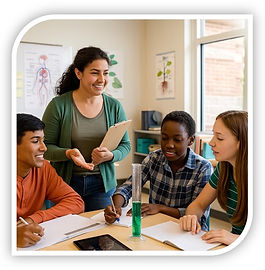
Inquiry in the Wild
Meet Tasha, a high school biology teacher at Prairie View School. Tasha teaches a multi-graded biology class in a rural setting where students span a wide range of abilities, backgrounds, and interests. Traditional labs and one-size-fits-all activities have fallen flat. Some students disengage, while others feel left behind. Tasha knows she needs to shift her practice, but isn’t sure where to begin.
Inspired by conversations with colleagues and student feedback, Tasha begins redesigning her science instruction around flexible grouping, layered inquiry tasks, and co-created pathways. By offering students choice in how they participate and demonstrate understanding, she begins to see a dramatic shift in engagement. Over time, her classroom transforms into a dynamic learning ecosystem, one that adapts to the needs of each student, rather than asking them to adapt to it.
-
Prologue - One Room, Many Needs ( 📖 Read | 🎧 Listen | 🎬 Watch )
-
Chapter 1 - Layered Inquiry Labs ( 📖 Read | 🎧 Listen | 🎬 Watch )
-
Chapter 2 - Planning With Purpose ( 📖 Read | 🎧 Listen | 🎬 Watch )
-
Chapter 3 - Group Dynamics Reimagined ( 📖 Read | 🎧 Listen | 🎬 Watch )
-
Chapter 4 - Student-Led Symposium ( 📖 Read | 🎧 Listen | 🎬 Watch )
-
Epilogue - Looking Back to Look Ahead ( 📖 Read | 🎧 Listen | 🎬 Watch )
▶ Story: Designing for Belonging

Designing for Belonging
Meet Kayla, a learning support teacher at Prairie View School who works with multiple classrooms across Grades 5 to 9. As part of her role, she often observes students disengaged from group work. Some withdrawing entirely, others dominating while peers become passive participants. She begins to notice a pattern: students’ reactions to group tasks often reflect their unmet sensory needs, unspoken communication preferences, or previous experiences of exclusion.
Rather than scrapping group work, Kayla leans into co-design with classroom teachers to develop flexible group structures rooted in autonomy, safety, and purpose. From redefining group roles to creating visual supports and co-constructed norms, Kayla helps teachers reimagine collaboration not as a rigid structure but as a living, responsive design. Her story illustrates how thoughtful systems-level design can dismantle invisible barriers and nurture belonging where it once felt out of reach.
-
Prologue - Structure Isn’t the Enemy ( 📖 Read | 🎧 Listen | 🎬 Watch )
-
Chapter 1 - Barrier Spotting ( 📖 Read | 🎧 Listen | 🎬 Watch )
-
Chapter 2 - Progression-Based Co-Planning ( 📖 Read | 🎧 Listen | 🎬 Watch )
-
Chapter 3 - Partnership Protocols ( 📖 Read | 🎧 Listen | 🎬 Watch )
-
Chapter 4 - Pathway Menus ( 📖 Read | 🎧 Listen | 🎬 Watch )
-
Epilogue - Co-Creation Culture ( 📖 Read | 🎧 Listen | 🎬 Watch )