


The Unity Pathways School Division (UPSD) and its schools are narrative settings created for The Belonging Project. The stories within this ecosystem are inspired by real experiences in education and community life, thoughtfully fictionalized to protect privacy and illuminate inclusive practice.


The Unity Pathways School Division (UPSD) and its schools are narrative settings created for The Belonging Project. The stories within this ecosystem are inspired by real experiences in education and community life, thoughtfully fictionalized to protect privacy and illuminate inclusive practice.
▶ Story: A Culture of Recognition: The Story of Priya
Course: Strength-Based Practice: Seeing Students Differently

At Emmaus Catholic School, a richly diverse K–9 Catholic community in an urban neighborhood, Principal Priya walks the halls with deep love for the students and families she serves. Many of her families are newcomers to Canada, bringing with them rich traditions, resilience, and multilingual experiences. And yet, in formal meetings and documentation, Priya notices a troubling pattern: conversations about these students often begin with what they lack.
“He doesn’t know enough English yet.”
“She struggles to make friends.”
“They don’t have any books at home.”
The narrative is subtle but harmful - a deficit lens that flattens identity and unintentionally positions families as problems to solve.
Priya knows this isn’t the whole story. In her hallway chats and casual playground greetings, she hears threads of pride—parents sharing how their children helped translate at immigration appointments, how they care for siblings, or how they sing traditional songs at family gatherings. These are gifts. But they rarely make it into the official record.
With quiet determination, Priya decides to disrupt the pattern. She begins asking different questions, modeling different language, and designing school practices that intentionally name and honor strengths. Over time, something shifts, not just in the tone of meetings, but in the school culture itself. Families feel seen. Students feel valued. And staff begin to realize: when we look for gifts, we find them.
-
Prologue - Unseen Gifts ( 📖 Read | 🎧 Listen | 🎬 Watch )
-
Chapter 1 - Listening for Strengths ( 📖 Read | 🎧 Listen | 🎬 Watch )
-
Chapter 2 - Reframing at the Edges ( 📖 Read | 🎧 Listen | 🎬 Watch )
-
Chapter 3 - Welcoming Through Story ( 📖 Read | 🎧 Listen | 🎬 Watch )
-
Chapter 4 - Rewriting the System ( 📖 Read | 🎧 Listen | 🎬 Watch )
-
Epilogue - A Culture of Recognition ( 📖 Read | 🎧 Listen | 🎬 Watch )
▶ Story: Hearts That Share
Course: Faithful Citizenship: Catholic Social Teaching, Civic Engagement, and Inclusive Education

Maren is a quiet three-year-old in Emmaus Catholic School's early learning program. She loves the feel of soft blankets, the sound of story time, and the comfort of playing near her educator, Ms. Rosa. But sharing toys? That’s still hard. When a new student, Ibrahim, joins the class and reaches for Maren’s favorite stuffed lamb, she clutches it tight and turns away. Ms. Rosa notices but doesn’t rush in. Instead, she begins to plan a gentle pathway toward understanding justice, kindness, and community.
The next day, Ms. Rosa introduces a storybook about Jesus feeding the crowd with loaves and fishes. The class wonders together: “Did Jesus keep the bread for himself?” Slowly, they start naming ways they can take care of one another in their classroom. A soft blanket goes to a crying friend. A snack is shared. A picture is drawn for someone who is sick. Ms. Rosa anchors the day in rhythms of welcome, sharing, and prayer. She incorporates these small but intentional acts of community rooted in Scripture and love.
Maren begins to soften. She watches as Ibrahim is included in circle time and gradually joins him at the sand table. When snack time comes and there’s one banana left, she offers it to him. Ms. Rosa catches her eye and smiles. That small moment, quiet and unprompted, is celebrated later during their prayer ritual. “Today, we saw God’s love in our class.”
Through picture books, liturgical symbols, and routines of empathy and belonging, Maren’s class begins to embody the heart of Catholic Social Teaching in ways that are deeply developmentally aligned. They’re not learning about CST yet but they are learning to live it.
-
Prologue - The Lamb and the Look-Away ( 📖 Read | 🎧 Listen | 🎬 Watch )
-
Chapter 1 - Jesus Shared the Bread ( 📖 Read | 🎧 Listen | 🎬 Watch )
-
Chapter 2 - Little Acts of Big Love ( 📖 Read | 🎧 Listen | 🎬 Watch )
-
Chapter 3 - Circle Time Community ( 📖 Read | 🎧 Listen | 🎬 Watch )
-
Chapter 4 - When the Banana Was Shared ( 📖 Read | 🎧 Listen | 🎬 Watch )
-
Epilogue - A Classroom That Loves ( 📖 Read | 🎧 Listen | 🎬 Watch )
▶ Story: We All Have a Place
Course: Faithful Citizenship: Catholic Social Teaching, Civic Engagement, and Inclusive Education

Alex is a cheerful and observant Grade 2 student at Emmaus Catholic School. He has complex physical and communication needs and uses both a wheelchair and an AAC (augmentative and alternative communication) device. Although his classmates are kind, they often don’t know how to include him in conversations, games, or shared activities. Teachers and staff sometimes default to having him watch from the sidelines, unsure how to meaningfully involve him in liturgies, group work, or daily classroom routines.
But when the class begins a Religion unit on the dignity of all persons and the Body of Christ, something begins to shift. Mrs. Santos, Alex’s teacher, shares Scripture about each member of the body being essential and invites the class to reflect: If everyone is part of the Body of Christ, what does that mean for how we include Alex? Together, they begin brainstorming and co-creating ways for Alex to be a full participant, in their prayer circle, in group work, in art projects, and even in planning a class liturgy.
Mrs. Santos collaborates with the learning support team to adapt materials and embed meaningful roles for Alex. Classmates learn to use his AAC device, help set up his materials, and begin to genuinely connect with him. He becomes more vocal and expressive, and his classmates begin to light up when he participates. Over time, Alex’s presence reshapes the class’s understanding of what it means to belong, not by being the same, but by being fully seen.
-
Prologue - He’s Just Watching ( 📖 Read | 🎧 Listen | 🎬 Watch )
-
Chapter 1 - One Body, Many Members ( 📖 Read | 🎧 Listen | 🎬 Watch )
-
Chapter 2 - Designing with Dignity ( 📖 Read | 🎧 Listen | 🎬 Watch )
-
Chapter 3 - Practicing Belonging ( 📖 Read | 🎧 Listen | 🎬 Watch )
-
Chapter 4 - Seeing With New Eyes ( 📖 Read | 🎧 Listen | 🎬 Watch )
-
Epilogue - He’s Not Watching Anymore ( 📖 Read | 🎧 Listen | 🎬 Watch )
▶ Story: Justice in Our Hands
Course: Faithful Citizenship: Catholic Social Teaching, Civic Engagement, and Inclusive Education

Mateo is a thoughtful, bilingual Grade 4 student at Emmaus Catholic School. Often quiet in large groups, he comes alive during partner work and when lessons are grounded in real-life situations. When his teacher, Mr. Baptiste, introduces a social studies unit on needs and wants, Mateo is struck by a chart showing food insecurity across Alberta. “But how can someone not have lunch?” he asks quietly. That one question becomes a spark.
Mr. Baptiste leans into this moment and connects it to the Catholic Social Teaching principle of the preferential option for the poor. The class begins a new inquiry: “What does Jesus ask us to do when someone is hungry?” Together, they explore Gospel stories of compassion, discuss the dignity of all people, and brainstorm ways to act in love and justice. Mateo becomes more engaged than ever. He volunteers to interview staff at the local food bank and helps translate for a visiting parent who speaks Spanish.
The class co-designs a project called Backpacks of Blessings: weekend food kits for families in their own school who may be struggling. Mateo takes on a quiet leadership role, coordinating supply lists, helping decorate the backpacks, and encouraging his classmates. He learns that justice is not only about ideas. It's about presence, action, and community. And in doing so, Mateo begins to see his voice, language, and faith as tools for change.
-
Prologue - That’s Not Fair ( 📖 Read | 🎧 Listen | 🎬 Watch )
-
Chapter 1 - Jesus Fed the Hungry ( 📖 Read | 🎧 Listen | 🎬 Watch )
-
Chapter 2 - What Can We Do? ( 📖 Read | 🎧 Listen | 🎬 Watch )
-
Chapter 3 - Packing With Purpose ( 📖 Read | 🎧 Listen | 🎬 Watch )
-
Chapter 4 - Not Just a Project ( 📖 Read | 🎧 Listen | 🎬 Watch )
-
Epilogue - Hands That Can Help ( 📖 Read | 🎧 Listen | 🎬 Watch )
▶ Story: Many Tongues, One Body
Course: Faithful Citizenship: Catholic Social Teaching, Civic Engagement, and Inclusive Education

Leyla, a Grade 6 student at Emmaus Catholic School, recently arrived in Canada as a refugee. She speaks very little English and often sits quietly at the edge of classroom activities. Her teachers know her as kind and observant, but she rarely volunteers in class and avoids drawing attention to herself. What most of her classmates don’t know is that Leyla has a remarkable singing voice, a deep connection to her faith, and a rich cultural history rooted in community, resilience, and prayer.
During Religion class, Ms. Silva introduces the idea of the Body of Christ and the Catholic Social Teaching principle of Participation. She invites students to reflect on how everyone is called to be part of the community, not just in theory, but in voice, presence, and action. When students begin discussing ways to symbolize this, they decide on a classroom art project: a collaborative mosaic that weaves together images, Scripture verses, and phrases from their families’ languages.
As the mosaic takes shape, so does Leyla’s sense of belonging. She quietly contributes a verse in her first language and eventually volunteers to sing a verse of a hymn during morning prayer. Her classmates begin to see her not as someone to “help,” but as someone they’re learning with and from. Through this journey, the class discovers that belonging isn't about everyone being the same. It's about everyone being needed. Leyla’s story becomes a living testimony to the sacredness of voice, culture, and participation in community life.
-
Prologue - A Quiet Presence ( 📖 Read | 🎧 Listen | 🎬 Watch )
-
Chapter 1 - One Body, Many Parts ( 📖 Read | 🎧 Listen | 🎬 Watch )
-
Chapter 2 - Our Words, Our Languages ( 📖 Read | 🎧 Listen | 🎬 Watch )
-
Chapter 3 - Singing Our Stories ( 📖 Read | 🎧 Listen | 🎬 Watch )
-
Chapter 4 - From Helping to Learning With ( 📖 Read | 🎧 Listen | 🎬 Watch )
-
Epilogue - Living Mosaic ( 📖 Read | 🎧 Listen | 🎬 Watch )
▶ Story: Roots and Responsibility
Course: Faithful Citizenship: Catholic Social Teaching, Civic Engagement, and Inclusive Education

Emmett is a thoughtful and analytical Grade 8 student at Emmaus Catholic School who thrives in science class but often disengages during Religion. He’s respectful but skeptical, regularly asking: “What does faith have to do with real-world problems?” His teachers appreciate his curiosity but aren’t always sure how to connect religious teachings to his love for inquiry and evidence. That begins to shift when Mr. Deluca introduces a unit on Laudato Si’, inviting students to examine the connections between Catholic Social Teaching and environmental responsibility.
As the class studies Laudato Si’, Emmett is surprised to find scientific principles echoed in papal writing. Climate change, sustainability, biodiversity. It’s all there. For the first time, he sees faith not as something separate from science, but as a lens for moral action. Energized, Emmett proposes an environmental audit of the school and assembles a student team to collect data on energy use, waste, and water consumption. The group creates a campaign to raise awareness and inspire change, grounded in both ecological science and Catholic teaching.
Throughout the project, Emmett evolves from a science-minded skeptic to a student-leader grounded in responsibility and care. Presenting their findings to the school council, he uses both Scripture and data to advocate for change. The experience reshapes how he sees Religion class: not as abstract doctrine, but as an invitation to action. Emmett’s story reminds us that when students are invited to explore faith through real-world relevance, they not only deepen their learning. They begin to lead.
-
Prologue - Faith Doesn’t Solve Climate Change ( 📖 Read | 🎧 Listen | 🎬 Watch )
-
Chapter 1 - Faith in the Facts ( 📖 Read | 🎧 Listen | 🎬 Watch )
-
Chapter 2 - Audit in Action ( 📖 Read | 🎧 Listen | 🎬 Watch )
-
Chapter 3 - Campaign for Change ( 📖 Read | 🎧 Listen | 🎬 Watch )
-
Chapter 4 - Presenting with Purpose ( 📖 Read | 🎧 Listen | 🎬 Watch )
-
Epilogue - Faith That Moves Forward ( 📖 Read | 🎧 Listen | 🎬 Watch )
▶ Story: From Learning to Leading
Course: Faithful Citizenship: Catholic Social Teaching, Civic Engagement, and Inclusive Education
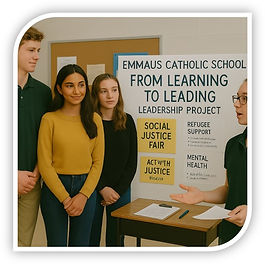
The Grade 9 class at Emmaus Catholic School is known for being thoughtful, but also hesitant to lead. So when their Religion teacher, Mr. De Luca, announces that they’ve been invited to plan the school’s first Catholic Social Justice Fair, the students respond with mixed reactions: some are excited, others overwhelmed. “What does that even mean?” one student asks. Another adds, “Why should anyone listen to us?”
Sensing their uncertainty, Mr. De Luca doesn’t push them toward action. Instead, he begins with discernment. He introduces the principles of Catholic Social Teaching (CST) and leads the students through Scripture passages that explore justice, solidarity, and the call to act. The class participates in discernment circles, examining global and local injustices and their own places within them. They reflect: What breaks your heart? What gives you hope? Where is God calling you to step forward?
Gradually, students begin forming teams around issues that resonate personally. They create teams related to housing insecurity, Indigenous reconciliation, ethical consumerism, mental health, and refugee support to name a few. Each group is paired with a mentor (a community partner, parish leader, or teacher) and begins designing an interactive display and a call to action for the fair. As ideas take shape, something shifts: the students stop waiting to be told what to care about and start leading.
On the day of the Social Justice Fair, the gym is transformed. Students share stories, statistics, Scripture, and solutions. Younger students sign action pledges. Teachers linger at booths. A local city councillor stops by and is visibly moved. The Grade 9 class closes the day in a prayer circle, naming what they’ve learned. For many, it’s the first time they’ve seen faith, justice, and leadership come together in a way that feels real.
-
Prologue - When Rigor Isn’t Reaching ( 📖 Read | 🎧 Listen | 🎬 Watch )
-
Chapter 1 - Not Built for Everyone ( 📖 Read | 🎧 Listen | 🎬 Watch )
-
Chapter 2 - Finding the Hook ( 📖 Read | 🎧 Listen | 🎬 Watch )
-
Chapter 3 - Access for All ( 📖 Read | 🎧 Listen | 🎬 Watch )
-
Chapter 4 - Inquiry as Expression ( 📖 Read | 🎧 Listen | 🎬 Watch )
-
Epilogue - Belonging by Design ( 📖 Read | 🎧 Listen | 🎬 Watch )